WEEKEND MAGAZINE (October 10 2009): Jaswant Singh's controversial Book on Jinnah, upholds the Founder's secular outlook. Mahommed Ali Jinnah never nursed hostility for the majority Hindu populace of India, nor for the Parsi's and Christians. Compilation of Jaswant Singh recalled the Genealogy of Jinnah prepared by Mrs. Gulshan Reza Chandoo that was printed in Business Recorder Independence Day issue of Friday, August 14, 2009.
Gulshan Chandoo is the mother of expatriate Hassan Chandoo, citizen of America. Hassan Chandoo and his wife Ra'azia nee Ali Asghar Ghulamali Habib of Winchester, State of New York, hold offices in the Democratic Party echelon. Hassan and Ra'azia played a key role in gathering the votes of Pakistani and Indian nationals settled in the East Coast of United States, for the election of their President Barak Hussain Obama during November 2008.
Hassan and Ra'azia's contribution was recognized by President Obama and First Lady Michelle Obama. They were invited to the inaugural ball in Washington.
For sure, Gulshan Reza Chandoo, daughter of Rajabali Ebrahim Batliwala, Jinnah's nephew and most trusted lieutenant in the Muslim League has first hand information of the descendants of Jinnah.
Be that it may be, Gulshan Chandoo has missed out from the Genealogical Table of August 14, 2009, the nomenclatures of Diana Nusli Wadia, grant-daughter of Jinnah and the Founders great grand sons Jay and Nez Wadia.
Marriage of Jinnah and his French Parsi wife Ruttie was solemnized on Friday April 19, 1918, synchronizing with the auspicious seventh day of Rajab, villadat (birthday) of Hazrat Abbas. From the union of Mohammed Ali Jinnah and Ruttie Jinnah nee Dinshaw Petit was born the daughter Dina in London, on August 14, 1919.
Dina wedded Neville Wadia in the All Saints Chruch of Bombay on November 15, 1938. Dina and Neville Wadia had two children, son Nusli, daughter Diana. She was delivered by her aunt Doctor Homie Wadia at the Saint Elizabeth's Nursing Home in Bombay, during the War Years of 1939-45. Diana is two years Nusli's Junior.
Unfortunately, Diana has been stricken with infantile polio that was rampant in pre-partition India. Unlike her elder brother Nusli, Diana avoids public eye.
There is the historical reference to Diana Neville Wadia that was given to me by Rajabali Ebrahim Batliwala when he took me to Ruttie Jinnah's graveside in Arambaugh of Bombay during October 1957.
Recorded in my Book "Chosen One's" Diana the five year old grand-daughter of the Founder, on the wheel chair, was at the gates of South Court on August 1, 1947, to bid adieu to her grandfather, Right Honourable Mohammed Ali Jinnah.
Founder lovingly kissed Diana and her elder brother Nusli on the forehead. Morning of August 1, 1947, Jinnah took leave of his immediate family at his Bombay residence, en route to New Delhi. Jinnah flew back from Bombay to New Delhi on the chartered Tata Airline Flight provided by Ruttie's nephew J.R. D. Tata, then Chairman of the Tata's conglomerate.
Plane for New Delhi/Bombay return was specially arranged by J.R.D. for Jinnah to see his medical consultant Doctor Jal Patel and radiologist Doctor Jal Daeboo in the last week of July 1947. Dina and her children Nusli and Diana are Roman Catholics. So is Maureen, Nusli's Brazilian wife and their two sons Jay and Nez Wadia.
Between the years 1997-1999 Jay was romantically involved, wooing Bolywood's leading film actress Juhi Chawla. Presently, the playboy Jay is regularly seen with India's leading actress (Sikh) Preti Zinta. Naturally, being non-Muslims, Jinnah's descendants remain in India.
They did not opt for Pakistan, for they did nurse the patriotic, fervour, zeal like for instance my Muslim entrepreneur Papa Haji Bhai Esmail Dossa. Being a Muslim, Papa was prompted to move from his settled home in Bombay to an unpredictable future in Pakistan.
Diana, the crippled grand daughter of Jinnah resides, in a sit-in apartment in Lourdes, adjacent to the monastery of Virgin Mary. Address and telephone Number was provided by Florence du Surmant, Neville Wadia's mistress in Morocote, Switzerland in October 1990.
I wrote to Diana and reached her on telephone in Lourdes when I was in Paris in the third week of October 1990 and again spoke to her from Geneva, during the third week of April 1995.
October 1990, behest of Florence du Surmant, my friend the Dentist Anwer Ali Ahmed and I secured an appointment with Diana. We were all set to take the train from Paris to Lourdes, when I received a call at the Neuilly Park Hotel of Paris.
Diana cancelled the arrangement, explained to me politely in fluent French that on second thoughts she prefers to continue remain incognito. Diana added she did not want her self to be photographed and definitively, she did not desire to see me and Doctor Anwer Ali Ahmed for the proposed interview.
Your E-mail and More On-the-Go. Get Windows Live Hotmail Free. Sign up now.


 In reference to Dr. Shahid Masood's recent column in Daily Jang, Asif Ali Zardari has pointed the involvement of a Muslim country in murder of his late wife and ex-Prime Minister Benazir Bhutto. Has Zardari accused Saudi Arabia in involvement of Benazir's Assassination? Is this the reason that Zardari has been insisting for UN investigation?
In the same column, Dr. Shahid Masood adds that the Americans shared this accusation with that country, and relations between Pakistan and that country have been strained since then. This was also reflected in a muted response by Saudis in Tokyo Conference of "Friends of Pakistan". This perception was further strengthened due to Zardari's inclination towards Iranians through direct and indirect contacts. Rehman Malik, who is responsible for interior affairs, went on special visit to Iran that was observed with suspicion as in obvious it was out of his Ministery's domain. This visit was followed by Zardari himself, which might have raised some reservations from Saudis.
In reference to Dr. Shahid Masood's recent column in Daily Jang, Asif Ali Zardari has pointed the involvement of a Muslim country in murder of his late wife and ex-Prime Minister Benazir Bhutto. Has Zardari accused Saudi Arabia in involvement of Benazir's Assassination? Is this the reason that Zardari has been insisting for UN investigation?
In the same column, Dr. Shahid Masood adds that the Americans shared this accusation with that country, and relations between Pakistan and that country have been strained since then. This was also reflected in a muted response by Saudis in Tokyo Conference of "Friends of Pakistan". This perception was further strengthened due to Zardari's inclination towards Iranians through direct and indirect contacts. Rehman Malik, who is responsible for interior affairs, went on special visit to Iran that was observed with suspicion as in obvious it was out of his Ministery's domain. This visit was followed by Zardari himself, which might have raised some reservations from Saudis.

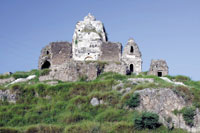 his tears when an inconsolable Shiva wept for his dead wife Sati. And so the pond is sacred to the Hindus. Among the tirathas in the subcontinent, Ketas, because of its connection with Shiva, ranks among the holiest. In this pond the devout tell their children to strew their ashes after they die, here they long to visit in their lifetimes. And when they do come, they carry away bottles of the sacred water – the magical talisman to cure all ills, to banish all worldly cares, to cleanse all impurities of body and soul.
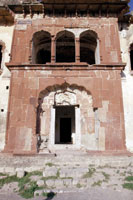 kilometre and a half to the north of Ketas. Having billeted himself there, the pilgrim visited the monastery and the stupa. He was horrified to see it deserted and without priests. The stupa, so Xuanzang tells us, had been raised by Asoka and was at the time of his visit in ruins.
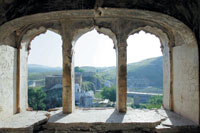 Nalwa's palace destroyed, its rafters removed to build other homes. In fact, the roofs of most of the buildings were dismantled and the material used elsewhere. In the mid-1980s a half-hearted attempt at restoration was made when a group of pilgrims were to visit from India. This was restricted to white-washing of a couple of buildings and no more.
