Saturday, September 24, 2011
SPECIAL POWER OF ATTORNEY (How to make)
Thursday, September 8, 2011
Fire goes out of Agha Khan's son's marriage
Thursday, September 1, 2011
Through hardships to the stars : St. Patrick's High School Karachi, turns 150 years old
During its first year, St Patrick's was a co-educational institution but in March 1862 five Sisters of the Daughters of the Cross along with Bishop Steins arrived from Europe and started a separate convent school for girls. Both schools continued to function directly under the management of the St Patrick's parish priest till 1893 after which the girls section was made entirely independent, and named St Joseph's Convent High School.
St Patrick's English School was registered a high school in 1867 and the first student to be sent for Matriculation was one Thomas Duncan in 1869 who eventually stood First Class First in the Bombay Presidency. The Society of Jesus remained in charge of the school for 74 years till June 4, 1935. It was then taken over by the Franciscan Order for 15 years from June 5, 1935 to October 6, 1950. Since then it has been administered by the Roman Catholic Archdiocese of Karachi and has been led by Pakistani principals now under the Catholic Board of Education which also owns and operates St Joseph's, St Paul's, St Lawrence's and the Convent of Jesus and Mary. In 1972, the Bhutto government nationalised St Patrick's College, which was finally returned to the Catholic Board in 2005.
"Nationalising such reputable educational institutions was one of the worst decisions of the ZA Bhutto government," Justice (retired) Wajihuddin Ahmed told The Express Tribune. He takes pride in being a student during the late 1950s and recalled how Father Stephen Raymond, who was the longest serving principal, left a deep impression on all his students.
Another illustrious former student, Javed Jabbar, recalled how he had initially gained admission to St Patrick's College in 1961 to the Commerce section, while his interest lay in Arts. "Father D'Arcy D'Souza came to my rescue, spoke firmly to my father and persuaded him to allow me to transfer to the Faculty of Arts which I loved," Jabbar told this newspaper. "I had the honour of helping win the trophy for St Patrick's in two debate competitions and also helped produce and edit the college magazine. We also set up a social welfare group to raise funds for charitable causes… and to get an opportunity to meet girls! The two years were brief but forever enduring in their impact on my life."
The school motto is the Latin phrase 'Per Aspera Ad Astra' which has also been one of the mottos for Nasa's space programmes and translates into English as 'Through hardship to the stars'.
The original building of the school on its present location was constructed by Rev Fr Jurgens in 1894 at a cost of Rs54,000 of which Rs14,000 were paid by the government as a grant.
The new main school building was completed in 1949 just in time to facilitate the growing number of students as many people migrated to Karachi after partition. The Archdiocese of Karachi was determined to meet the burgeoning needs of education in the independent Pakistan.
According to Principal Father Joseph Paul today the school has more than 5,500 students and 350 teachers and administrative staff.
In 1961, under Principal Rev Fr S Raymond, a memorable centenary celebration was held to mark 100 years of St Patrick's which was attended by president Ayub Khan, Zulfikar Ali Bhutto and the Khan of Kalat. In 1986, prime minister Junejo attended the 125th anniversary.
In June 2005, L K Advani visited while on a trip to Karachi. He had attended the school from 1936 to 1942 and recalled his first meeting with then president Pervez Musharraf, "After learning that he too was a former student, the first subject we discussed was our school and nearly 20 minutes of our 45-minute meeting were devoted to St Patrick's!"
The same year the school honoured Musharraf. Paying tribute to his teachers Father Raymond, Father Todd and Simon D' Lima he said, "Their mentoring made a big difference in my life. My brother was a better student, so I would get punished by Mr D' Lima for not doing as well in Math. Later, I … excelled in it…thanks to those reprimanding reminders I got from Mr D' Lima!" He even recalled the spanking he once received from Father Todd, "I wanted to sit on a block of ice after that experience!"
'Old Patricians'
Pervez Musharraf
Asif Ali Zardari
Shaukat Aziz
Muhammad Khan Junejo
L K Advani
Air Marshal Azim Daudpota
Jam Sadiq Ali
Jam Yousuf Ali
Muzaffar Hussain Shah
Yusuf Haroon
Mohammed Ayub Khuhro
Agha Siraj Durrani
Javed Jabbar
G Allana – former Mayor of Karachi
Justice Edward Raymond – first Indian appointed Judicial Commissioner by the British
Justice C. M. Lobo – former Judicial Commissioner of Sindh, Chairman of the Public Service Commission and Pakistan's delegate to the UN
Rizwan A. Fazeel ( Presently in USA)
Business
Several members of the Habib, Adamjee, Bhimjee (EFU), Avari, Haroon (Dawn) clans as well as Ashfaq Hussain and Jerome D'Silva (Hussain-D'Silva), Tanveer Jamshed (Teejays), Masoom Alam (Masoom's Bakery), Leon Menezes (GM HR Shell Pakistan), Deepak Perwani (designer), Zouhair A Khaliq (former president Mobilink/Orascom)
Clergy
H E Valerian Cardinal Gracias – former Archbishop of Bombay, first cardinal from sub-continent, elevated in 1953
H E Dr. Joseph Cardinal Cordeiro (Oxford) – former Archbishop of Karachi, first cardinal from Pakistan elevated in 1973 and after the death of Pope John Paul I. stated as a "papabile" (likely to be elected Pope) by Time magazine in October 1978
Several archbishops of Islamabad-Rawalpindi, Allahabad, Delhi, Belgaum, Ahmadabad, Hyderabad, Bombay, Poona and Calcutta
Sports
Wallis Mathias
Wasim Bari
Iqbal Sikander
Danish Kaneria
Faisal Iqbal
L Fernandez
O B Nazareth
P P Fernandez (India)
M D'Mello
J Britto Olympians (Hockey)
Educationists
Rev Fr Edward D'Cruz – former Principal St. Xavier's College, Bombay
Leo D'Souza – former Principal DJ Science College, Karachi
Prof Adil Najam – Lead author for the Intergovernmental Panel on Climate Change (IPCC), which was awarded the 2007 Nobel Peace Prize along with Al Gore. Teaches at Boston University and has previously taught at MIT, University of Massachusetts and at the Fletcher School of Law and Diplomacy
Media
Late Mahmoud Haroon
Nadeem Farooq Paracha
Humayun Saeed
Mir Shakil-ur-Rehman
Rizwan Wasti
Abdullah Kadwani
Louis (Gumby) Pinto
Military
Rashid Minhas Shaheed Nishan-i-Haider, the youngest and PAF's only recipient of Pakistan's highest gallantry award
Gen Jehangir Karamat
Air Chief Marshal Farooq Feroze Khan
Air Marshall Azim Daudpota
Lt Gen Muzaffar Hussain Usmani
Vice Admiral Ahmad Hayat
Lt Gen Eric A Vas – Indian Army
Air Vice Marshal Erlich Pinto – Indian Air Force
Squadron Leader Peter Christy Sitara-e-Jurat, Shaheed, 1971
(submitted by)
Chaudhry Ahmed Khan
Advocate High Courts
Cell: 0300 2172379
Monday, August 22, 2011
21st Ramazan is Death Anniversery of Hazrat Ali.
Ali ibn Abi Talib
(ca. 596-661)
Cousin and son-in-law of Muhammad (S A A W). In 656 he became the last of the "rightly guided" caliphs. The fourth of the caliphs or successors of Muhammad, was born in Mecca. His father, Abu Talib, was an uncle of the Prophet, and Ali himself was adopted by Muhammad and educated under his care.
While a boy, he distinguished himself by being one of the first to declare his adherence to the cause of Muhammad. Some years afterwards he married the Prophet's daughter Fatima Zahra. Ali proved himself to be a brave and faithful soldier, and when Muhammad died without a male heir, some thought Ali to have the best claim to succeed Muhammad. Not until 656, after the murder of Uthman, the third caliph, however, did Ali assume the title of caliph. Certain conspirators later claimed that he took no steps to prevent this murder, but other sources claim that Ali sent his sons to defend Uthman, and was angered when they were unable to protect him.
The question of Ali's right to succeed to the caliphate is an article of faith which divided the Muslim world into two great sects, the Sunni and the Shia. The Sunnis believe that the prophet chose Abu Bakr to be the first caliph, while the Shia believe that he chose Ali. Ali did not challenge Abu Bakr or any of the later caliphs, however, but rather served as an advisor to them.
Ali is greatly respected by all Muslims, both Sunni and Shia. The Shia venerate him as second only to the prophet, and call him among several titles the "Leader of the Faithful" (Amir-ul-mumineen) and the "Lion of God" (Sher-i-Khuda), and celebrate the anniversary of his death. In the eyes of later Muslims he was a remarkable scholar, and he wrote many collections of proverbs and verses. The most famous collection of Ali's speeches and letters is the Nahj ul Balagha, "The peak of eloquence".
He is entombed in the grand shrine at Najaf in modern Iraq, although some believe he is buried at Mazar-e Sharif in Afghanistan. His sons Hasan and Husayn are also revered by Muslims, especially the Shia.
Chaudhry Ahmed Khan Advocate High Courts Cell: 0300 2172379Sunday, June 5, 2011
he graph of the logarithm to base 2 crosses the x-axis (horizontal axis) at 1 and passes through the points with coordinates (2, 1), (4, 2), and (8, 3). For example, log2(8) = 3, because 23 = 8. The graph gets arbitrarily close to the y-axis, but does not hit it.
The logarithm of a number is the exponent to which a fixed number, the base, has to be raised to produce that number. For example, the logarithm of 1000 to base 10 is 3, because 1000 is 10 to the power 3: 1000 = 103 = 10 × 10 × 10. More generallyT, if x = by, then y is the logarithm of x to base b, and is written logb(x), so log10(1000) = 3.
Logarithms were introduced by John Napier in the early 17th century as a means to simplify calculations. They were rapidly adopted by scientists, engineers, and others to perform scientific computations using slide rules and logarithm tables. These devices rely on the fact that the logarithm of a product is the sum of the logarithms of the factors:
The present-day notion of logarithms comes from Leonard Euler who connected them to the exponential function in the 18th century.
The logarithm to base b = 10 is called the common logarithm and has many applications in engineering. The base of the natural logarithm is the constant e (≈ 2.718). It is widespread in pure mathematics, especially calculus. The binary logarithm uses base b = 2 and is prominent in computer science.
Logarithmic scales reduce wide-ranging quantities to smaller scopes. For example, the decibel is a logarithmic unit quantifying sound pressure and voltage ratios. In chemistry, pH is a logarithmic measure for the acidity of an aqueous solution. Logarithms are commonplace in scientific formulas, measure the complexity of algorithms and of geometric objects called fractals, and appear in formulas counting prime numbers. They describe musical intervals, inform some models in psychophysics, and can aid in forensic accounting.
In the same way as the logarithm reverses exponentiation, the complex logarithm is the inverse function of the exponential function applied to complex numbers. The discrete logarithm is another variant; it has applications in public-key cryptography.
Chaudhry Ahmed Khan Advocate High Courts Cell: 0300 2172379
Thursday, June 2, 2011
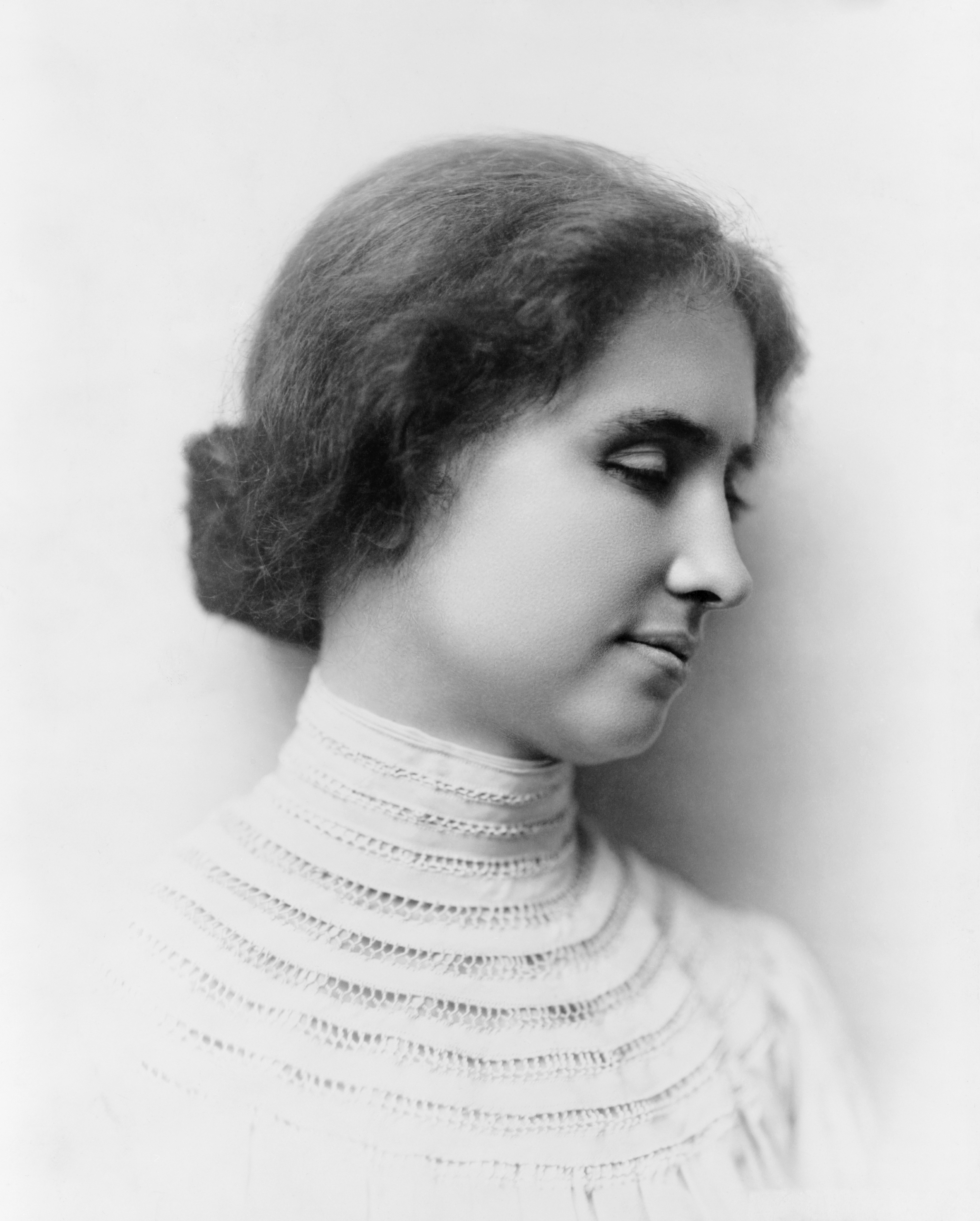
Helen Keller
Helen Keller (1880–1968) was a deafblind American author, political activist, and lecturer. The story of how Keller's teacher, Anne Sullivan, broke through the isolation imposed by a near complete lack of language, allowing the girl to blossom as she learned to communicate, has become widely known through the dramatic depictions of the play and film The Miracle Worker. A Prolific author, Keller was well-traveled, and was outspoken in her opposition to war. A member of the Socialist Party of America and the Industrial Workers of the World, she campaigned for women's suffrage, workers' rights, and socialism, as well as many other leftist causes.
Chaudhry Ahmed Khan Advocate High Courts Cell: 0300 2172379